

Haimhausen Castle
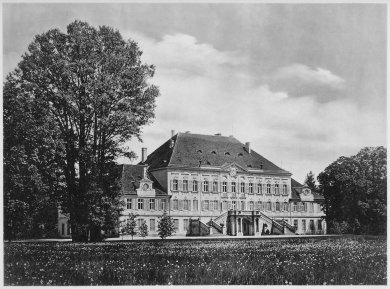
As early as the 12th century, there was a "castrum in Heimenhusen" or a "burkh Haimenhusen," but according to historians, this manor house was located on the hill above the parish church. It was destroyed by Palatine troops in 1504 during the War of the Bavarian Succession and was not rebuilt on that site.1 The history of Haimhausen Castle at its present location dates to the late 16th century.
The Manor House
Until 1590, the Haimhausen lordship belonged to the Wittelsbach family of Munich and was administered by ducal administrators. One of the last ducal administrators was Wolfgang Viepeckh, Doctor of both laws and Bavarian Chancellor in Landshut.
His son, Theodor Viepeckh, received the Hofmark (estate) Haimhausen, which also included Ottershausen, Inhausen, Maisteig, and the Inhausen Moos, as a fief in 1590 and, thirteen years later, even as an allodium (hereditary property). Theodor served Duke Wilhelm V as a financial expert and rose to the position of President of the Court Chamber under the Duke's son, Maximilian I. In 1615, he received from the German Emperor the right to use the name and coat of arms of the old Lords of Haimhausen, who had been enfeoffed with the Lordship of Haimhausen in the 12th and early 13th centuries.
Theodor Viehpeckh was the lord of the manor from 1590 to 1626. Owning the manor entailed considerable administrative responsibilities. These included manorial rights, lower jurisdiction, public order, notary services, church patronage, conscription rights, and the power to levy taxes. To manage these diverse tasks, Theodor built a new manor and administrative center near the Amper River, with a castle at its heart - today known as the old “Hofmarkschloss” (manor castle).
During the Thirty Years' War, this first castle was burned down by Swedish troops in 1632, but rebuilt by Theodor's son, Johann Albrecht von Haimhausen (1626–1659). It is depicted in a copper engraving by Michael Wening from around 1700 (the long building at the top of the clipping shown below, with the castle chapel at its western end). The castle, along with its chapels, the Mayr House, the Judge's House, the brewhouse, the guesthouse, and the stables, are grouped around a horseshoe-shaped courtyard featuring a "beautiful stone fountain with 17 figures and 100 waterspouts (‘springendten Wassern’)."3 The mill on the other side of the Mühlbach (creek) also belongs to this old castle complex. The fountain, however, is likely to have been built shortly before 1700.
The chapel of the old castle is believed to have been built around 1670. It was commissioned by Johann Albrecht's son, Franz Albrecht von Haimhausen, who was the lord of the manor from 1659 to 1687 and was raised to the rank of baron in 1671.2
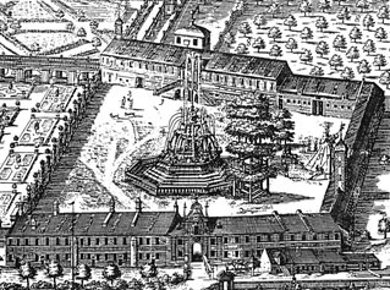
Detail from the copper engraving " Schloss Haimbhausen" by Michael Wening, 1700
The pleasure pavilion and the Baroque gardens and water features
Under Franz Ferdinand von Haimhausen, the next lord of the manor from 1687 to 1724, the palace grounds experienced their most splendid Baroque embellishment. He was very close to Elector Max Emanuel, who appointed him president of the Privy Council, the highest decision-making body in Bavaria. When the Elector was governor of the Netherlands from 1692 onwards, Franz Ferdinand served as his representative in Bavaria. In a decree of 1694, the Elector ordered: "Furthermore, Haimhausen's instructions are to be carried out as if they came from the Elector himself."4
To emphasize his status as the Elector’s deputy, he commissioned the construction of a magnificent pleasure pavilion (“Lusthaus”) on an artificial hill around 1690, in keeping with the spirit of the age. It served as a venue for festivals, hunts, and receptions.
The architect of this palace is not definitively known. Enrico Zuccalli and Giovanni Viscardi are mentioned; the construction was apparently overseen by the Munich court painter Johann Andreas Wolff.4 Next to the pleasure pavilion, which could be reached via a sweeping driveway or a magnificent staircase, was a flower garden with a basin featuring "springing waters". The staircase led first to an elevated "Italianate garden (‘welsche Gärtl’)" and from there to the pleasure pavilion. Beneath this staircase and garden complex was a grotto.
The pleasure pavilion and its associated gardens, parks, water features, and ponds are also documented in Michael Wening's copperplate engravings.
In 1692, Franz Ferdinand was elevated to the rank of Imperial Count (‘Reichsgraf’) by the Emperor.
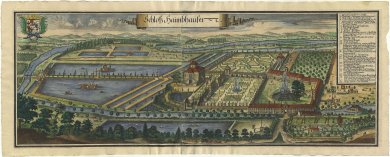
"Schloß Haimbhausen", copper engraving by Michael Wening, 1700
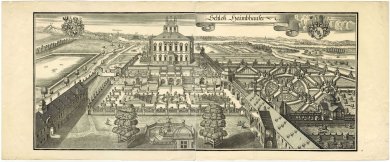
"Schloß Haimbhausen" with pleasure pavilion, copper engraving by Michael Wening, 1700
With the outbreak of the War of the Spanish Succession in 1705, the baroque splendor of Haimhausen also came to an end. The Elector was in exile, and Franz Ferdinand increasingly neglected his Haimhausen estate, failing to make necessary investments. The situation did not improve after his death, when Haimhausen was administered by guardians of his grandchildren from 1724 to 1731. The baroque gardens and the pleasure pavilion fell into disuse, and the old castle and its farm buildings deteriorated.5
As early as 1708, Franz Ferdinand had stipulated by decree that the estate should pass undivided to his eldest son, Franz Joseph. However, Franz Joseph died - like five of his brothers - while his father was still alive. The only surviving son, Karl Joseph, entered the Jesuit order and became one of the important founding fathers and reformers of Chile; thus, he was excluded from the line of succession in Haimhausen.
In the last years of his life, Franz Ferdinand limited investments in Haimhausen to the bare minimum, but designated his younger grandson Sigmund Ferdinand as the sole heir to the entire estate. After his grandfather's death, Sigmund deviated from this testamentary disposition and divided the vast inheritance, which included extensive lands in Bohemia as well as numerous properties in Bavaria and Munich, with his older brother Karl Ferdinand. By drawing lots, Karl received Haimhausen, while Sigmund inherited the Bohemian estates, including the mines.6 7
The New Rococo Palace
After years of decay due to neglect and inheritance disputes, Karl Ferdinand von Haimhausen took over the estate in 1731. The new lord of the manor (from 1731 to 1775) was also in the service of the Elector. He was chamberlain, privy councillor, and member of the regional assembly.
Karl Ferdinand commissioned the court architect François Cuvilliés the Elder to design a new castle. Cuvilliés integrated the old, long-unused pleasure pavilion into the central section of the three-winged building. During the construction phase (1747–1750), the artificial hill was removed, and a passageway was created in place of the underground grotto. Above this were the salon and a magnificent ballroom. The southern wing housed the castle chapel. The Augsburg stuccoist and sculptor Egid Verhelst and his sons Ignaz Wilhelm (1729–1792) and Placidus (1727–1778), as well as the Augsburg painter and academy director Johann Georg Bergmüller, who created the ceiling frescoes in the ballroom and the magnificent chapel, were involved in the construction of the palace.4 6
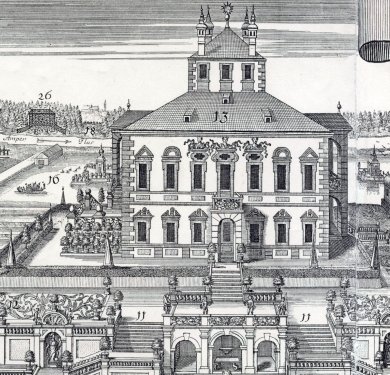
The pleasure pavilion in the park of the old manor house
Detail from the copper engraving "Schloß Haimbhausen" by Michael Wening, 1700
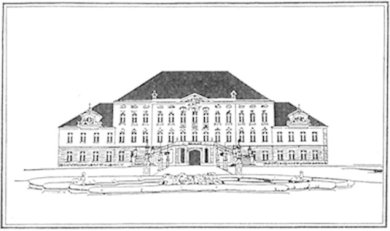
The Rococo palace after 1750
When Karl Ferdinand died in 1775, his younger brother Sigmund Ferdinand laid claim to the manor. He invoked his grandfather's inheritance law, which stipulated sole succession through the male line. After a seven-year legal battle with his brother's widow and two daughters, he was finally able to take possession of the inheritance in 1782.
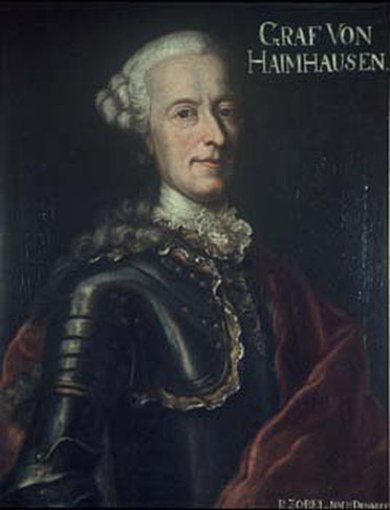
Sigmund Reichsgraf von und zu Haimhausen (1775-1793)
Sigmund was an innovator who foresaw the decline of feudalism and trained himself as a skilled mining expert on his Bohemian estates and in the mines there. Emperor Charles VII had already appointed him Master of the Mint of Bohemia; his son, the Bavarian Elector Max Joseph III, appointed him President of the Electoral Mint and Mining College in 1751. In this capacity, Sigmund initiated coal mining in Bavaria to reduce excessive timber consumption. He was also the founder and director of the Nymphenburg Porcelain Manufactory, as well as a founding member, first president, and later honorary president of the Bavarian Academy of Sciences.
To remedy the dampness in the castle walls, Sigmund had the terraces and open staircases demolished, along with the beer cellars beneath them. In the castle's stairwell, he placed two valuable wooden sculptures—Apollo and Diana—which the renowned sculptor Roman Anton Boos had created for him in 1783. The sculptures are still preserved in the castle today.8
Count Sigmund Ferdinand von und zu Haimhausen died in 1793 without leaving a male heir.
The Counts Butler von Clonebough
Since Karl Ferdinand and Sigmund Ferdinand had left only daughters, but the inheritance laws stipulated a male descendant, a renewed inheritance dispute arose after Sigmund's death. This was decided in favor of Count Theobald Josef Paul Butler von Clonebough, the grandson of Franz Ferdinand's daughter Maria Susanna, who had married the Bohemian Count Theobald Wenzel Butler in 1721 without her father's knowledge or consent. Count Theobald Josef did not inherit the estate himself, but instead bequeathed it to his eldest son, Sigmund Joseph Hubert Butler, who took possession in 1794.9
In his early years as lord of the manor, Sigmund Joseph resided primarily in Hungary and Vienna, where he accumulated considerable debts. He even considered selling the estate, but was dissuaded by his family. When the burden of debt finally caught up with him, he returned to Haimhausen, but without making any significant improvements or investments. Since he had no legitimate children, his brother Kajetan, a general in Bavarian service living in Würzburg, persuaded him to transfer the estate to his nephew, Kajetan's son Theobald, in exchange for the settlement of the debts. The handover took place on October 1, 1829.
On the same day, Theobald Count Butler von Haimhausen married Viktorine Edle von Ruedorffer, the wealthy daughter of a Munich merchant, who later founded numerous social institutions, including the present-day institution for the disabled in Schönbrunn.
Theobald held various public offices as Royal Bavarian Chamberlain, as President of the District Council for Upper Bavaria, and from 1840 to 1866 as an elected member of the Bavarian Parliament.11
In his memoirs, he vividly describes the difficult starting point of his estate: “It is not easy for anyone to have taken over such a completely ruined fortune, such a dilapidated estate management, with so little understanding of the true nature of the estate, and without any practical economic and administrative knowledge as I did. But I brought enthusiasm, energy, diligence, and tireless activity to the business.”10
With the law of 1848, the manorial estates and their jurisdictions were abolished in Bavaria. Count Butler thus lost his manorial rights, as well as the patrimonial court of the second class and his large noble hunting grounds within a 10-hour radius.
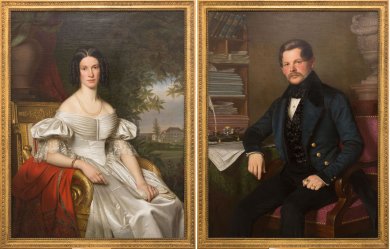
Viktorine and Count Theobald Butler von Haimhausen
With the transfer of the judge to Dachau, his living quarters and offices in the judge's house, today's “Kavalierhaus”, became vacant. Countess Viktoria opened an institution there in January 1854 for 16 poor and neglected children who would otherwise have been a burden on the community. In mid-1856, with the support of the Bavarian king, she leased the premises of the abandoned Indersdorf Monastery and transferred the Haimhausen children there. Soon, 130 children were being cared for there. Two years later, the Sisters of Mercy of Munich took over the management of the institution.10
After a fire destroyed the inadequately insured farm buildings, Count Butler fell into serious financial difficulties. In this situation, the count, whose health was also failing, decided in 1867 to transfer the estate to his eldest son, Theobald Moritz. Theobald had married Fernandine (Nandine) Treherne-Treherne, the daughter of an English gentleman living in Switzerland, on June 24, 1867. Her dowry of 100,000 guilders made it possible to save the financially struggling estate. Theobald Moritz had previously pursued a military career and was a Royal Bavarian Chamberlain and retired Captain. His marriage remained childless.
Even in his youth, Count Theobald Moritz had caused his father much grief due to his extravagant lifestyle and high debts. Even as lord of the manor, he was unable to put his Haimhausen estate on a sound financial foundation.
As his financial situation deteriorated further, he finally decided to sell his property. On October 29, 1892, the wealthy industrialist Eduard James Haniel acquired the castle, the estate, and the castle's businesses for 1.25 million marks. The new owner was ennobled in Bavaria a year later and henceforth bore the name Haniel von Haimhausen.
The Castle under the Haniel Family
Eduard James Haniel von Haimhausen, born in 1844 and former chairman of the supervisory board of Gute-Hoffnungshütte in the Ruhr region, was already 58 years old when he took over the estate in Haimhausen. He was married to his cousin Henriette, née Haniel. The marriage remained childless.
James Haniel von Haimhausen carried out significant changes throughout the entire castle grounds. The castle, neglected by his predecessor, underwent a thorough interior renovation, including the construction of a central hall extending to the upper floor. Of greater architectural significance, however, was the reorientation of the castle to the west. A monumental open staircase was built on the west facade, topped by a decorative gable bearing the Haniel coat of arms.
Between 1893 and 1897, the castle park to the west was also completely redesigned. Inspired by English landscape gardens, expansive meadows were created, interspersed with elegant groups of trees, giving the grounds a new, prestigious appearance.4
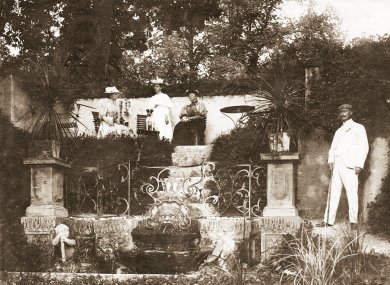
James Eduard Haniel von Haimhausen
Eduard James Haniel died in 1904; his widow Henriette, who initially held the usufruct, continued to manage the castle's operations until her death in 1913. In 1908, she had married Count Anton von Monts, a diplomat and German envoy to Rome. After her death, he leased the castle and its associated businesses from 1914 to 1925. The lessor was Eduard James Haniel's nephew, Dr. Edgar Karl Alfons Haniel von Haimhausen, who had been granted the entire Haimhausen estate as part of his uncle's inheritance arrangements.
Dr. Edgar Karl Alfons Haniel von Haimhausen, a Royal Prussian Cavalry Captain in the Reserve, assumed personal management of the Haniel businesses in 1925. He served for many years in the diplomatic service and in the autumn of 1918 was part of the delegation led by Matthias Erzberger that conducted the armistice negotiations with the Allies. The following year, as a ministerial representative, he was a member of the German peace delegation in Versailles. Later, he served as State Secretary and representative of the Reich government in Bavaria, with his official residence in Munich.13 He died in 1935.
His son, Günter Eduard Berthold Haniel von Haimhausen (born 1908), inherited the castle and its estate. Although he no longer lived in the castle, he continued to manage the estate and its businesses until his death in 1998.
During the Second World War, the castle was unoccupied. The castle chapel served as a storage room for the Bavarian State Library, where books were stacked to the ceiling. Props and costumes of the Bavarian State Opera were stored in the castle itself.
Between 1946 and 1949, the castle housed the Munich Academy of Fine Arts under the direction of Professor Adolf Schinnerer, until its reconstruction in Schwabing. From 1949 to 1951, the Bavarian Finance School occupied the castle's rooms, followed by the Bavarian School for Legal Clerks (1952–1965). Between 1965 and 1975, the castle served as the Munich Police Academy. From 1976 to 1986, all 35 rooms were rented to a renowned antiques dealership, which offered furniture, jewelry, and other antiques for sale.3
In 1983, Günter Haniel von Haimhausen sold the castle and its gardens to Hans Daxer and Luise Piëch, a granddaughter of Ferdinand Porsche. The couple had both the castle and the castle chapel extensively renovated between 1983 and 1985. In 1989, it received the Monument Protection Medal for this achievement.3
In 1997, the Bavarian International School acquired the castle property and has since used the rooms for educational and administrative purposes. Additional new buildings were constructed for school operations, but these are located at a certain distance from the castle so as not to unduly impair its protected status.14
[1] Ludwig Erlebach: 400 Jahre Schlossareal Haimhausen, Haimhauser Kulturkreis e.V. 2008, p. 5
[2] Ludwig Erlebach: 400 Jahre Schlossareal Haimhausen, Haimhauser Kulturkreis e.V. 2008, p. 6
[3] Markus Bogner: Haus- und Hofchronik von Haimhausen, 1999/2006, unpublished; Ortsarchiv Haimhausen
[4] Ulrike Kretschmar: Das alte und das neue Schloß Haimhausen, Publications from the Institute of Art History at the University of Munich, tuduv-Verlag 1986
[5] Ludwig Erlebach: 400 Jahre Schlossareal Haimhausen, Haimhauser Kulturkreis e.V. 2008, p. 8
[6] Ludwig Erlebach: 400 Jahre Schlossareal Haimhausen, Haimhauser Kulturkreis e.V. 2008, p. 13
[7] E. Rummer: Zur Geschichte Haimhausens, Der Isargau Journal, 3rd Year 1929
[8] Ludwig Erlebach: 400 Jahre Schlossareal Haimhausen, Haimhauser Kulturkreis e.V. 2008, p. 15f
[9] Ludwig Erlebach: 400 Jahre Schlossareal Haimhausen, Haimhauser Kulturkreis e.V. 2008, p. 18
[10] Graf Theobald Butler von Haimhausen; Erinnerungen, Memoiren und Tagebuchaufzeichnungen, unpublished manuscript
[11] Gabriele Donder-Langer: Viktorine und Theobald Butler von Clonebough – Eine Ehe im Biedermeier, unpublished manuscript
[12] Ludwig Erlebach: 400 Jahre Schlossareal Haimhausen, Haimhauser Kulturkreis e.V. 2008, p. 24f
[13] Ludwig Erlebach: 400 Jahre Schlossareal Haimhausen, Haimhauser Kulturkreis e.V. 2008, p. 28f
[14] Ludwig Erlebach: 400 Jahre Schlossareal Haimhausen, Haimhauser Kulturkreis e.V. 2008, p. 41